
This article is not about installing software or setting up servers. It is about understanding what shifts when you stop treating AI as a question-and-answer tool and start treating it as a background contributor. For marketers especially, this shift is where the real time savings live.
What "agentic" actually means for a marketer
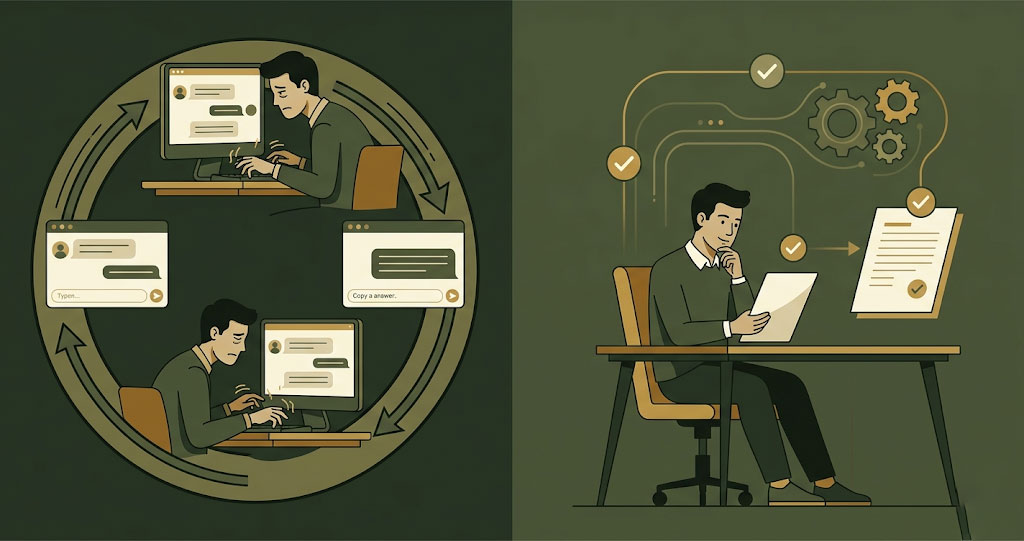
Let us skip the industry definitions and talk about what changes in practice. A standard AI workflow looks like this: you have a task, you open a chat, you write a prompt, you get a response, you copy it, you close the chat. The AI does nothing until you tell it to. Every step requires your attention.
An agentic workflow looks like this: you define a role for the AI (“you are my content repurposing assistant”), you give it rules (“turn each blog post into three social posts and one email snippet, using this brand voice guide”), and you give it a trigger (“every time I publish a new post”). The AI produces drafts. You review them when they are ready. You are no longer in the loop for every generation step, only for the decisions.
That distinction, being in the loop for decisions instead of execution, is the entire difference. It is not about removing the human. It is about removing the human from the parts of the workflow that do not need human judgement.
What marketers can actually hand off (including agentic AI for customer service)
The following examples are not hypothetical. These are workflows that work today with existing AI tools, no custom development required.
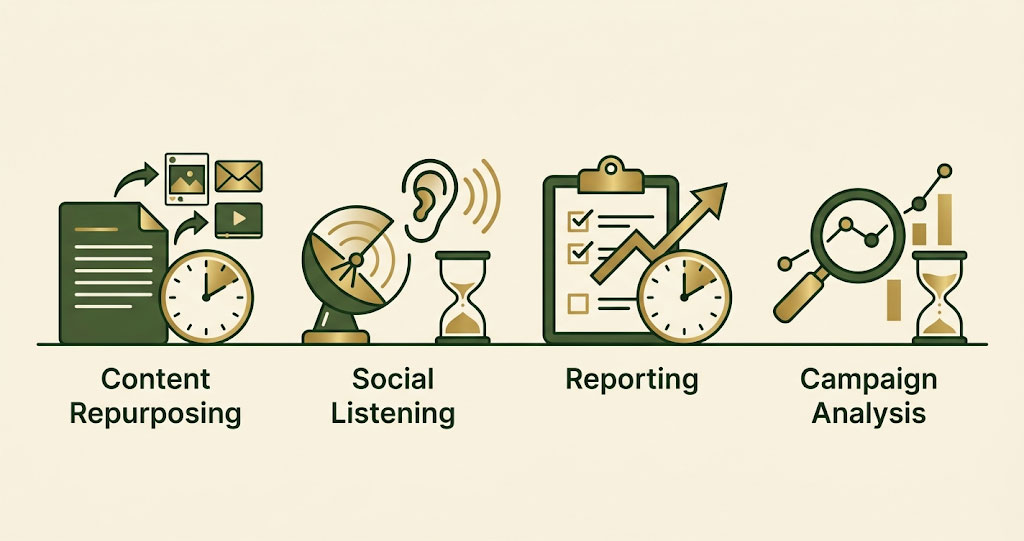
Content repurposing pipeline
You record a podcast episode, publish a blog post, or film a video. Instead of manually extracting quotes, rewriting for different platforms, and formatting each variant, you set up a workflow that does it in the background. The AI reads your source content, applies your platform-specific formats (long-form for LinkedIn, short hooks for Twitter, visual-friendly for Instagram), and presents you with drafts to approve.
The time saving here is not just the writing. It is the context switching. Instead of spending 45 minutes repurposing a piece of content across three platforms, you spend five minutes approving and tweaking drafts. The difference is not 40 minutes. It is that you stay in strategic mode instead of dropping into execution mode.
Social listening and brand monitoring
Instead of manually scrolling feeds to see what people are saying about your brand or your industry, you set up a monitoring workflow that scans mentions, summarises sentiment shifts, and alerts you only when something worth your attention happens. The AI does not replace your judgement about how to respond. It replaces the scanning time.
The key is defining what “worth your attention” means. An agentic workflow lets you set thresholds: alert me only on negative sentiment spikes, mentions above a certain engagement threshold, or questions that signal purchase intent. Everything else gets summarised in a daily digest. You stop reacting to noise and start responding to signals.
Weekly and monthly reporting
Reporting is one of the most repetitive tasks in marketing that still requires human oversight. The numbers need to be interpreted, not just listed. An agentic workflow pulls the data, identifies trends and anomalies, and drafts a narrative around what changed and why. You review the narrative, add context the AI cannot know (a campaign change you made, a market shift), and publish.
This turns a two-hour reporting session into a 20-minute review. The AI handles the data gathering and the first pass at the story. You handle the strategic context and the decisions.
Campaign performance analysis
This is a variation of reporting but specific enough to call out separately. Instead of digging through dashboards to compare campaign performance, you set up a workflow that continuously evaluates your active campaigns against historical benchmarks, flags underperformers, and suggests possible causes.
The AI does not make the optimisation decision. It surfaces the pattern: this ad set dropped in conversion rate after Tuesday, and the drop correlates with a change in audience targeting. You decide what to do about it. But you find out about it hours or days earlier than you would by spot-checking dashboards.
“I set up a content repurposing workflow that runs every time I publish. It saves me roughly four hours a week. But the real win is that I stopped skipping repurposing entirely because it felt like too much effort. Now everything I create gets distributed everywhere, automatically.”
From the Insight Division Labs free course
Where the human still belongs
Agentic workflows are not about full automation. They are about shifting where you spend your time. Here is what stays squarely in the human domain:
Strategy and direction. Agentic workflows execute on a brief you define. They do not create the brief. Deciding what to say, to whom, and why is still your job. The AI handles the “how” of distribution and formatting, not the “what” of the message itself.
Brand voice oversight. The AI can follow a voice guide, but it cannot feel whether a piece of copy sounds right for your specific audience in this specific moment. That judgement call stays with you.
Relationship decisions. Any communication that affects a real relationship, whether with a client, a partner, or an audience, needs human review. The AI drafts. You decide.
Creative direction. Agentic workflows can repurpose content. They cannot tell you what your next content piece should be about. That requires understanding your audience's unspoken needs, your competitive position, and your business priorities. All human work.
How to start without overcomplicating it
The biggest mistake marketers make with agentic workflows is trying to build a system before they understand the task. Start the same way you start any AI workflow: pick one task and run it manually three times with all the context the AI needs. If it works, gradually move toward a more autonomous setup.
For content repurposing, that means writing a single detailed prompt that covers your brand voice, your platform formats, and your approval process, then testing it on one piece of content. Once it produces reliable output, you set up the trigger (new content published) and let it run.
For reporting, it means defining exactly what metrics matter, what format the report should follow, and what constitutes a flag worth escalating. Test the narrative output on one week of data. When it is reliable, let it run and shift your role from compiler to reviewer.
The rule is the same as the 80/20 principle in our earlier article: get one workflow working reliably before you start another. A single agentic workflow that saves you five hours a week is worth ten half-working experiments that save you nothing.
The bottom line
Agentic workflows are not a futuristic concept. They are a practical shift in how you use the AI tools that already exist. Instead of treating AI as a chat window you open and close a hundred times a day, you treat it as a team member that works alongside you, handling the repeatable parts of your workflow and surfacing the decisions that actually need you.
For marketers, the prize is not just time saved. It is the ability to stay in strategic mode instead of constantly dropping into execution. That shift alone changes what is possible in a working week.
If you are not sure where to start, the free Insight Division Labs course walks through three practical AI setups. Two of them, competitor research and background briefings, can easily become agentic workflows once you understand the manual process first.